

An album cover is a visual and commercial object, but it can also be a source for studying its time. It does not tell the whole story of an album, nor is it a transparent window into musicians’ intentions. It does, however, invite questions about identity, censorship, politics, design and commerce. With a simple method, students can learn to separate what they see from what they infer, and to look for evidence before forming an interpretation.
1. Describe before interpreting
Begin with literal observation. Which people, objects, words and shapes appear? Which colours dominate? Where is the title, and what receives the most attention? Is the image a photograph, an illustration or a combination? Write down only what any viewer could verify by looking at it.
Then ask about visual choices: what is placed in the centre and what is left out? Does the typeface seem formal, handmade, futuristic or aggressive? Does the composition suggest order, movement, intimacy or confrontation? These words are interpretations, not facts. Each claim should point to a visual detail that supports it.
2. Identity and representation
Who is represented, and how? Does the image construct an individual, a band or a community? Which identities are visible, and which are absent? Consider clothing, gesture, position, space and gaze. A cover may reinforce a deliberate public image, but it cannot by itself tell us how artists defined themselves or how every listener interpreted them.
If possible, compare it with photographs, interviews, advertisements or other materials from the same period. Differences between sources can be revealing: a promotional image may simplify a scene, while other documents show its diversity. Ask who made the design decisions too: artists, photographers, art directors, record companies or some combination.
3. Censorship, politics and limits
A cover may offer clues about social norms and controversy, but do not infer censorship merely because an image seems provocative. Look for evidence: alternate versions, design changes, warnings, cropping, documented bans or contemporary testimony. Ask who had the power to decide what could be distributed and to which audience.
Politics is not always an explicit message. It can lie in the use of symbols, who occupies the space or how an identity is presented as a challenge. But political interpretation needs context and alternatives: what else might the image mean? Which sources support or weaken each reading?
4. The record as a product
A cover also sells. It must distinguish a record, attract attention and communicate an identity in shops, advertisements or catalogues. Consider whether the design seems to address a particular audience and what value it promises. Think about how its role changes as music moves from vinyl to smaller formats, screens and digital platforms. The medium affects size, visibility and how the image is shared.
In class, finish with a short conclusion that separates observation, interpretation and evidence. “The cover shows…” is not the same as “The cover means…”. Add a question you still cannot answer and name the source that might help. This turns an image into an investigation rather than a guessing game.
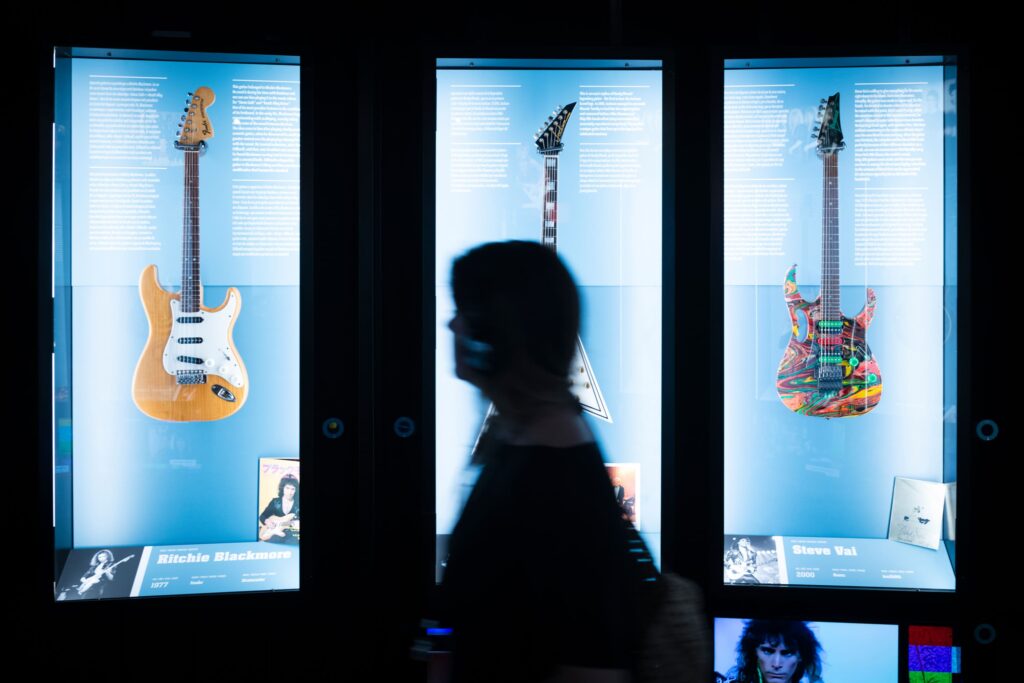
The Museu del Rock brings images, songs, instruments and documents together in a timeline of popular music. This kind of context helps us read visual objects as part of cultural history: not only what a cover depicts, but who circulated it, when and for whom.