

When people talk about the history of rock in Spain, Madrid usually gets all the attention. La Movida, the Florida Park, Radio Futura, Alaska. There’s a dominant narrative that places the capital at the center of the musical explosion of the 1980s.
But that narrative is incomplete. And Barcelona has much more to say than is usually acknowledged.
The Origins: the Sixties and Contraband Rock
The history of rock in Barcelona starts before the Transition, in a far more hostile context. In the 1960s, with the dictatorship at full strength, rock was a suspicious genre: it came from America, it spoke of a freedom the regime couldn’t allow, and its electric sound and physical rhythm were seen as a moral threat.
Despite everything, rock arrived. It came through the port’s sailors, through foreign tourists, through contraband records passed from hand to hand. And it found fertile ground in Barcelona, a city with its own cultural tradition and a young population looking for reference points outside official Spain.
Groups like Els Setze Jutges and the Nova Cançó scene coexisted, in a tense and creative way, with the first electric rock bands. The relationship between linguistic commitment and Anglo-Saxon influence generated a productive tension that defined Catalan musical culture for decades.
The Transition: Everything Is Possible (and Everything Is Chaos)
Franco’s death in 1975 and the years of Transition opened the floodgates in a way the cultural system wasn’t prepared to manage. Suddenly it was possible to release records that hadn’t been possible before, to play at venues that had been closed, to say things that couldn’t be said.
Barcelona was one of the centers of this explosion. The Barcelona punk and post-punk scene of the late seventies and early eighties produced bands and artists who are now part of the history of Spanish popular music, but who rarely appear in mainstream articles.
The Eighties: The Scene Nobody Saw Coming
While Madrid was building the narrative of La Movida, Barcelona was doing its own work, less loudly but equally consistently. Catalan-language rock found its golden age in this decade: Sau, Sopa de Cabra, Els Pets, Sangtraït. Bands that filled arenas and proved that a minoritized language could have a world-class rock scene.
At the same time, the Spanish-language scene and the influence of Anglo-Saxon rock remained active. Barcelona didn’t choose a single path: it chose all of them at once, and that plurality is one of its strengths.
The Museu del Rock as Custodian of This Memory
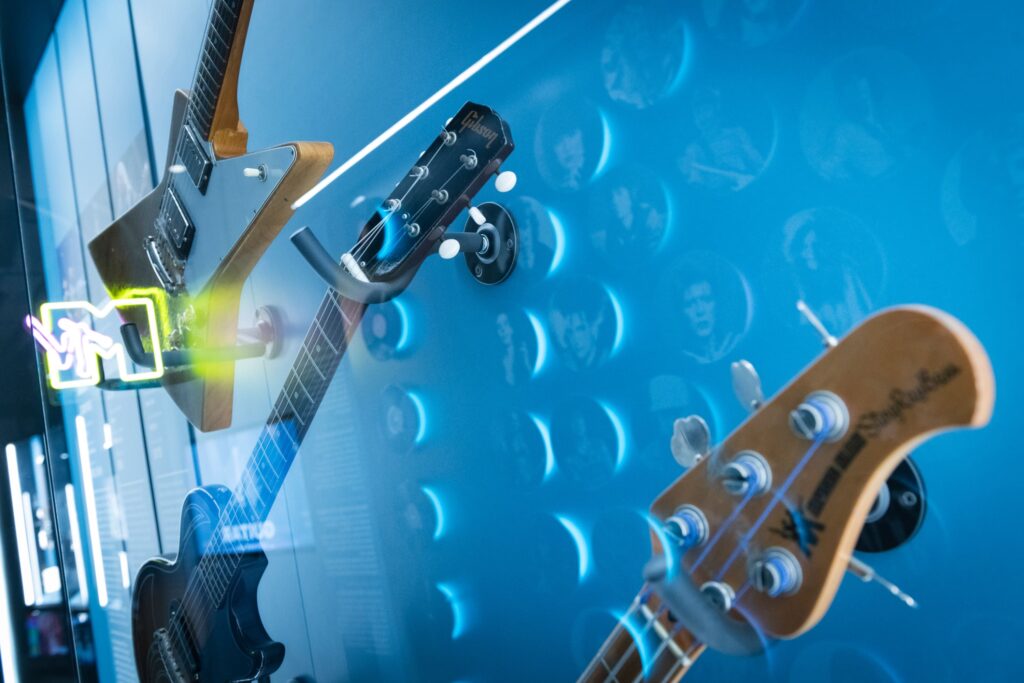
The history of rock in Barcelona is rich, complex and insufficiently documented. The Museu del Rock Barcelona is one of the spaces working to change that: not only from a local perspective, but by situating the Barcelona and Catalan scene within the global narrative of rock as a cultural phenomenon of the twentieth century.
The guitars and instruments they preserve aren’t just objects: they’re witnesses to a history that goes far beyond notes and chords. A history that Barcelona has lived firsthand, and that deserves to be told with the rigor and passion it merits.